
IT Consulting & Digital Transformation
Service Overview
IT consulting for Lebanese businesses planning infrastructure upgrades, cloud adoption, security improvements and digital transformation.
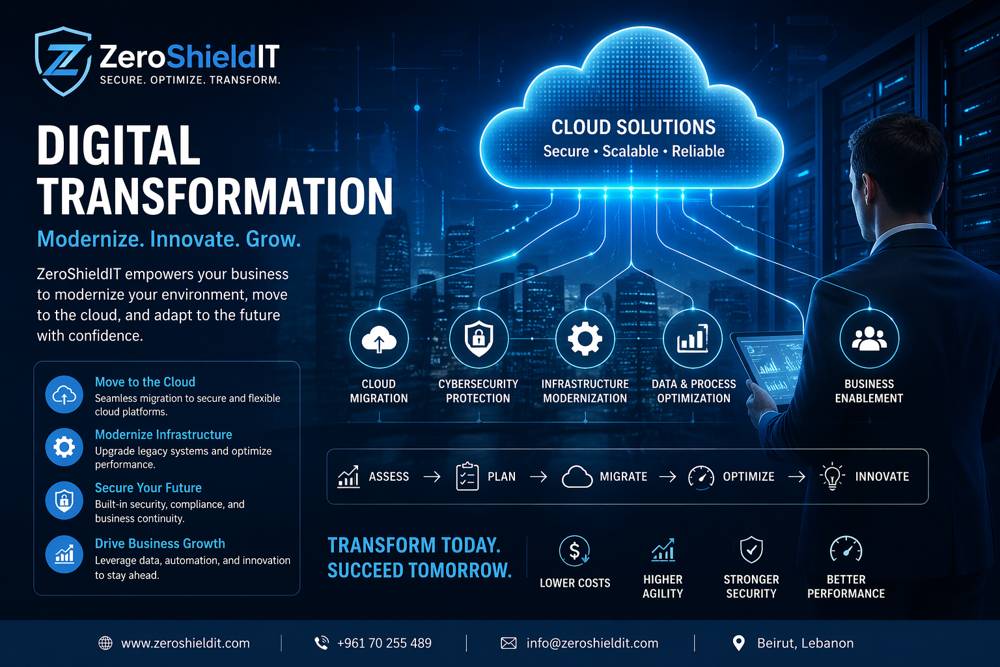
IT consulting for Lebanese businesses planning infrastructure upgrades, cloud adoption, security improvements and digital transformation.
IT Consulting for Businesses in Lebanon
Technology decisions become difficult when infrastructure has grown without a plan, recurring problems consume time, or several possible projects compete for the same budget. IT consulting helps a business understand its current environment, define priorities, and plan changes around operational needs rather than isolated products.
ZeroShield IT provides consulting for businesses planning infrastructure upgrades, cloud adoption, security improvements, modernization, or a clearer technology roadmap. The engagement can focus on a specific decision or review several connected areas when the business lacks a complete view of its IT environment.
Who Benefits from IT Consulting?
- Businesses planning a server, network, cloud, or office infrastructure upgrade.
- Companies experiencing recurring technical problems without a clear root cause or improvement plan.
- Growing organizations adding employees, locations, applications, or new operational requirements.
- Businesses evaluating cloud, security, backup, collaboration, or automation changes.
- Organizations with ageing or unsupported systems that need a practical transition sequence.
- Decision-makers who need to compare priorities before committing budget to several technology projects.
IT Assessment and Discovery
An assessment begins by understanding what the business does, which systems employees depend on, and where technology currently creates risk or unnecessary work. Depending on scope, the review can include:
- Infrastructure: Servers, workstations, storage, virtualization, hosted resources, and equipment condition.
- Networks: Connectivity, Wi-Fi, firewalls, remote access, office layout, and recurring performance issues.
- Cloud and business applications: Where systems run, how they connect, who uses them, and whether the current arrangement supports future requirements.
- Cybersecurity: Accounts, access, endpoint and network controls, known gaps, and operational responsibilities.
- Backup and recovery: What is protected, how recovery is expected to work, and whether important assumptions have been tested.
- Users and devices: Onboarding, offboarding, support needs, device management, recurring user problems, and whether the business maintains an accurate IT asset inventory for lifecycle and planning decisions.
- Operations: Documentation, suppliers, responsibilities, recurring incidents, and technology tasks that depend on one person.
Building a Technology Roadmap
Assessment findings should be organized into practical priorities rather than one undifferentiated list. Depending on the engagement, recommendations can be grouped as:
- Immediate risks: Issues that expose important systems, data, or operations and require prompt attention.
- Short-term improvements: Changes that address recurring problems, unsupported components, documentation gaps, or straightforward operational weaknesses.
- Medium-term projects: Planned infrastructure, cloud, network, security, backup, or application changes that require budget and coordination.
- Long-term modernization: Larger transitions that should be sequenced around business growth, equipment lifecycle, application change, or process improvement.
The level of documentation and planning depends on the scope agreed with the business. Consulting does not require every recommendation to be implemented at once.
Infrastructure and Cloud Planning
Infrastructure decisions should consider applications, users, locations, connectivity, security, recovery, support, lifecycle, and cost together. A server replacement may lead to a local, hosted, or hybrid design rather than an automatic cloud move.
Related planning can include platform-neutral cloud infrastructure, Azure workloads and operations, or business network and Wi-Fi infrastructure. Consulting helps determine which specialist project is appropriate and in what sequence.
Cybersecurity and Risk Planning
Security planning considers what the business relies on, which threats and failures matter most, where responsibilities sit, and which improvements should be prioritized. This may include identity and access, endpoints, networks, email, backups, user practices, monitoring, and response preparation.
Ongoing controls can be addressed through cybersecurity services. A scoped, authorized point-in-time assessment is handled separately through penetration testing. Recovery priorities should also be coordinated with backup and disaster recovery planning.
Digital Transformation in Practical Terms
Digital transformation should describe a real operational change, not simply the purchase of new software. It may involve replacing repeated manual steps, improving collaboration, connecting business systems, modernizing an ageing application or infrastructure component, or improving how information moves between employees and departments.
- Reducing repeated data entry between forms, spreadsheets, email, and business applications.
- Improving access to current documents and information for the right employees.
- Replacing an unsupported or unreliable process in manageable stages.
- Defining where human review remains necessary before automating a task.
- Connecting compatible systems so approved information moves more consistently.
When the selected improvement requires workflow implementation and application integration, our separate workflow automation service can handle the defined automation project. The consulting page remains focused on assessment, priorities, and implementation planning rather than targeting n8n implementation directly.
Technology Selection and Implementation Planning
A technology decision should be based on documented requirements rather than feature lists alone. We can help the business consider alternatives using factors such as:
- Compatibility with current applications, infrastructure, data, and user workflows.
- Security, access, backup, recovery, and administrative requirements.
- Licensing, implementation, migration, training, support, and ongoing operational costs.
- Expected lifecycle and the risk of creating a new unsupported dependency.
- Business disruption, testing, rollback considerations, and implementation sequence.
- Which work can be completed internally and where specialist implementation is required.
This planning does not assume one vendor or platform is suitable for every requirement, but it also does not claim complete vendor independence. Existing contracts, systems, skills, and support responsibilities are part of the evaluation.
IT Consulting vs Managed IT Support
IT consulting is project-oriented and decision-focused. It assesses the current state, evaluates options, defines priorities, and plans change. Managed IT support provides ongoing operational assistance for users, devices, supported systems, and recurring technical issues.
A business may use consulting to define a roadmap and managed support to help operate the resulting environment.
Discuss Your Technology Priorities
Tell us what is changing in the business, which problems keep returning, and which technology decisions are currently unclear. Contact ZeroShield IT to define an assessment or consulting scope.
Need help securing your business?
We help businesses protect their systems, data, and networks.
Contact us on WhatsApp